Quick Answer: The best way to get rid of a double chin depends on its cause. Kybella® may work well for localized fat and patients who want to avoid surgery, while neck liposuction may be better for larger amounts of fat. Skin elasticity and neck anatomy also help determine the right treatment.
The neck and jawline are problem areas for many patients, both male and female. A crisp, defined jawline is often associated with a more youthful appearance, while excess fat under the chin can make patients feel self-conscious about their profile.
As the first doctor in the Boston area to offer my patients Kybella®, an injectable treatment for submental fat, as well as a surgery and liposuction expert, I have over 15 years of experience treating a double chin. The most confusing part for many patients is deciding which procedure is right for them: Kybella® or liposuction. While some patients, particularly men, are drawn to Kybella® because it is non-surgical, the best treatment ultimately depends on your individual anatomy, the amount of fat present, and the quality of your skin. Proper patient selection is truly the key to an exemplary result, which is why I always begin with an in-person consultation to assess the underlying causes of your double chin.

Key Takeaways
- Kybella® may be a good option for localized fat beneath the chin in patients who want a non-surgical treatment.
- Liposuction may be better suited for larger amounts of fat or patients who want more direct contouring.
- Skin elasticity, fat distribution and overall neck anatomy are important when choosing the right treatment.
What Causes a Double Chin?
Everyone carries fat in certain areas of the body, even thin people, and much of this comes down to genetics. For some patients, that area is under the chin. This is why I often see younger patients with very taut skin who still have a double chin. In general, however, submental fullness is often related to aging, weight gain, or a combination of the two.
Over time, the skin produces less collagen and elastin, which affects its ability to remain firm and “snap back” into place. Certain lifestyle factors can further accelerate the loss of skin elasticity, including:
- Excessive sun exposure
- Smoking
- Poor diet
- Weight gain and loss
The result can be looser, sagging skin, particularly along the lower face and neck. Aging can also affect the platysma, the major muscle of the neck, making excess fat beneath the chin appear even more noticeable.
This combination of fat, skin laxity, and underlying anatomy is why determining the cause of your double chin is so important. It also helps determine which treatment may be best for you.
What Are the Best Ways to Get Rid of a Double Chin?
The best treatment for a double chin depends on what is actually causing it. For patients with localized fat beneath the chin and good skin elasticity, Kybella® or liposuction may both be effective options. Kybella® offers a non-surgical approach, while liposuction allows me to remove fat more directly in a single procedure.
If loose skin is also contributing to the problem, simply reducing the fat may not be enough. This is why I look at the entire neck and jawline before recommending treatment. The goal is not just to remove fat, but to choose the procedure that will create the best contour for your individual anatomy.
What is Kybella and How Does It Work?
Kybella® is a non-surgical injectable treatment for reducing fat beneath the chin. Its active ingredient is deoxycholic acid, a molecule that occurs naturally in the body and helps break down and absorb fat. When Kybella® is injected into submental fat, it destroys the treated fat cells. Once destroyed, those cells can no longer store or accumulate fat.
According to the FDA-approved prescribing information for Kybella®, it is indicated for adults with moderate to severe fat beneath the chin. Because it targets the fat itself rather than loose skin, the quality of your skin and your overall neck anatomy are important when deciding whether it is the right treatment for you.
Does Kybella Really Work?
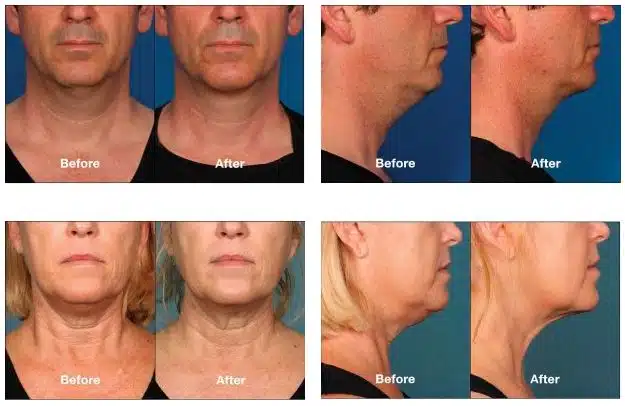
Kybella® can be very effective in the right patient. Clinical research supports its ability to reduce submental fat. In a phase III randomized controlled trial, 66.5% of patients treated with deoxycholic acid achieved at least a one-grade improvement in submental fat, compared with 22.2% of patients receiving placebo.
The important distinction is that Kybella® is designed to reduce fat beneath the chin; it cannot correct every reason that someone may have a poorly defined neck or jawline. Results also develop gradually and will vary depending on the amount of fat being treated and your individual anatomy.
In my experience, the key to getting a good result with Kybella® is proper patient selection. This is why I look closely at the fat, skin, and overall contour of the neck before recommending treatment.
Who is a Good Candidate for Kybella?
The ideal candidate for Kybella® is someone with localized fat beneath the chin and enough skin elasticity for the skin to re-form over a leaner jawline. In general, I look for:
- A localized pocket of fat beneath the chin
- Good skin elasticity
- Minimal to moderate skin laxity
- Realistic expectations about what Kybella® can achieve
- A preference for a non-surgical treatment
The amount and distribution of fat also matter. If your entire neck is thick with excess fat, neck liposuction may be a better option because it allows me to treat a larger piece of real estate and more directly contour the jawline.
Some patients simply do not want surgery. I get it. With them, I am always extremely honest about what Kybella® can realistically achieve.
What Should You Expect From Kybella Treatment?
Kybella® often requires more than one session, and results develop gradually over time. The number of sessions will depend on the amount of fat being treated and your individual goals.
Swelling is the most common side effect and can be fairly noticeable, especially after the first treatment. You may also experience temporary soreness, bruising, numbness, or firmness in the area. These and other potential reactions are outlined in the Kybella® prescribing information.
While Kybella® does not require surgical recovery, I still recommend planning around the expected swelling, particularly if you have an important event coming up.
Kybella vs. Liposuction for a Double Chin
Kybella® and liposuction can both reduce fat beneath the chin, but they work very differently. The first option is non-surgical and typically requires a series of treatments, with results appearing gradually. Liposuction is a surgical procedure that removes fat directly through a small cannula, allowing me to contour a broader area of the neck and jawline in a single procedure.
For some patients, the appeal of neck liposuction is that I can address a broader area of fat and shape the jawline more directly in a single procedure.
Liposuction does involve a surgical recovery period, including temporary swelling and bruising, but it may be more appropriate when there is a larger amount of fat or when more precise contouring is needed.
Patients with a smaller, localized pocket of fat who want to avoid surgery may be better suited for Kybella®. When there is more extensive fat throughout the neck, I may recommend neck liposuction instead. As always, the best choice depends on your anatomy and your goals.

What If You Have Loose Skin Under the Chin?
Fat is only part of the equation. If you also have significant loose skin beneath the chin or along the neck, removing the fat alone may not produce the definition you are looking for.
In these cases, I may recommend combining fat reduction with a procedure that addresses skin laxity or considering a surgical option. This is another reason why evaluating the skin, fat and underlying anatomy together is so important.
How Do You Choose the Right Double-Chin Treatment?
There is no single procedure that is right for every double chin. Some patients are excellent candidates for Kybella®, while others will achieve a better result with liposuction or a treatment that also addresses loose skin.
This is why I always start with an in-person consultation. By assessing the amount and location of the fat, your skin elasticity, and the overall anatomy of your neck and jawline, I can recommend the treatment that makes the most sense for you.
If you are bothered by a double chin and would like to understand your treatment options, I invite you to schedule a consultation at my Boston or Chestnut Hill office or call (617) 450.0070. Together, we can determine what is contributing to your concerns and discuss the approach that is most appropriate for your anatomy and goals.

Sean T. Doherty, MD, FACS, is a board-certified plastic surgeon and Boston native with experience in surgical and non-surgical aesthetic procedures. His practice includes facial aesthetics, breast surgery, body contouring, liposuction, injectables, and laser-based treatments. Dr. Doherty’s approach emphasizes individualized treatment planning, patient safety, and natural-looking results.
Relevant Credentials
- Medical Degree: Tufts University School of Medicine
- Board Certification: American Board of Plastic Surgery
- Professional Experience: Boston Center for Plastic Surgery, 2014–present
- Medical Leadership: Associate Medical Director, Cynosure Lutronic
Areas of Expertise
Facial aesthetics, breast surgery, body contouring, liposuction, injectables, and laser-based aesthetic treatments.